Capacity per course (see table)
Admission via the "Études en France" portal
Admission is via the ULCO Candidat portal for students who have earned between 60 and 120 ECTS credits or who have an equivalent level of study.
As soon as you have been accepted onto a BUT or a vocational bachelor’s degree programme, please contact the university’s disability support service if necessary.
| Training courses | Capacity |
BUT in Biological Engineering Food Science and Biotechnology | 32 places |
BUT in Biological Engineering Environmental Sciences and Environmental Technologies | 32 places |
| BUT in Electrical Engineering and Industrial IT | 42 places |
| BUT IT | 66 places |
| BUT in Business and Public Administration | 52 places |
| BUT Careers in Energy Transition and Energy Efficiency | 42 places |
| BUT Logistics and Transport Management | 28 places |
| BUT Communication techniques | 84 places |
| BUT Industrial Engineering and Maintenance | 28 places |
| BUT Administrative and commercial management of organisations | 54 places |
BUT Administrative and Commercial Management of Organisations – Course Management of cultural, artistic, sporting and tourism activities | 28 places |
| BUT GIM |
| ||||
| BUT GEA |
| ||||
| BUT INFO | 810 | ||||
| BUT GEII |
| ||||
| BUT GB |
| ||||
| BUT MT2E |
| ||||
| BUT MLT | 247 | ||||
| BUT TC |
| ||||
| BUT GACO |
|
To improve success rates, the IUT places particular emphasis on educational innovation. Staff are showing increasing interest in this area. They take part in training courses organised by the university’s Centre for Educational Innovation (CIP) and put these methods into practice: gamification of activities, problem-based learning and the flipped classroom.
Experiments are regularly carried out, such as the creation of educational games, self-assessment or peer assessment (by students).
ICT is widely used: computer-equipped practical work rooms, projectors in lectures and tutorials, the use of voting devices, the creation of collaborative learning spaces, the establishment of a radio studio, and the use of digital platforms (Moodle, Mindview). Attendance is systematically monitored by assigning a mark for each resource. This system has helped to improve students’ regularity and engagement with their work and has reduced the drop-out rate in the first semester. Continuous assessment has also been reinforced through short tests, quizzes, pop-quizzes and multiple-choice questions using voting devices.
In the first semester, some modules are taught in tutorial groups rather than in lectures.
As part of its student support initiatives, the IUT offers student jobs provided by the university to enable students to tutor those experiencing difficulties. The IUT also participates in a regional programme to support students wishing to pursue a long-term course of study following the BUT (Regional Programme for Success in Long-Term Studies – PRREL). Furthermore, at the start of the academic year, each department is allocated a budget of 80 hours by the local education authority as part of the Student Guidance and Success Scheme (ORE). These hours are mainly used to provide students with methodological support, tutoring and refresher sessions, revision and marking of written assignments, additional tutorial sessions (particularly at the start of Semester 1), workshops on soft skills and motivation, etc. Furthermore, the IUT has set up an ‘Innovation’ centre.
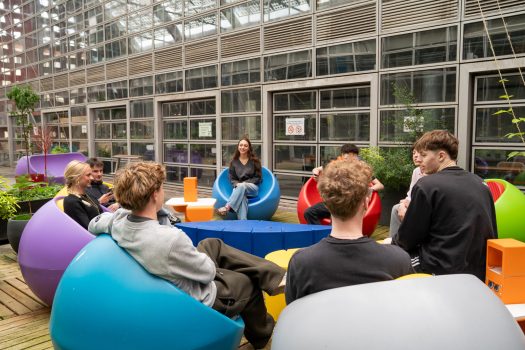
There is no dedicated student life committee at the IUT. However, student life is very much present through the student societies, which are eligible for project-based grants from the IUT and/or the university. One example is the refurbishment of an entire dining area at the Calais site, which was partly funded by the CVEC (Student and Campus Life Contribution). Various small areas have also been set up in different parts of the lobbies at the Saint-Omer and Calais sites to encourage interaction and a friendly atmosphere (high tables with USB charging sockets, armchairs, beanbags, etc.).
Our students are fully integrated into the university and have access to all the services it offers (CROUS, RU, student welfare officer, medical services, library, sports facilities, etc.). At the start of the academic year, all new students are invited to the ‘Explor’ULCO’ induction days, which are designed to help them discover the university and introduce them to all the services on offer in a fun and engaging way.
| Prerequisites | Objectives |
| The BUT GIM programme in Saint-Omer offers a course of study tailored to students who have taken the general baccalaureate with a specialisation in physics and chemistry, and those who have taken the STI2D technological baccalaureate. | The aim of the Bachelor’s degree in Industrial Engineering and Maintenance (GIM) is to train intermediate-level technicians, over the course of six semesters, to acquire recognised skills in installing, maintaining, securing and improving multi-technical systems, and to contribute to the management of a department’s technical and human resources. |
| The BUT GEA programme in Calais offers a course of study tailored to students with general or technological A-levels in the tertiary sector. | The Bachelor’s degree in Business and Public Administration aims to train versatile managers capable of understanding the legal, digital, economic and social environment of organisations at national and/or international level. The aim is to provide these managers with in-depth knowledge of law, accounting and taxation, as well as management, enabling them to contribute to the steering of organisations at every stage of their development. The aim is also to train professionals who are equipped to address the new challenges facing organisations, particularly in relation to sustainable development, corporate social responsibility and ethics, as well as technological change. |
| The BUT INFO programme in Calais offers a course of study tailored to students with a general A-level in science and those with an STI2D A-level (digital stream). | The IT departments at IUTs offer a three-year course to train IT specialists who are involved in the design, development and implementation of IT solutions that meet organisations’ digital transformation needs. Senior IT technicians work in digital services companies (ESNs), software publishers and the IT departments of businesses (banks, insurance companies, retail, manufacturing, e-commerce platforms, etc.). |
| The BUT GEII programme in Calais offers a course of study tailored to students who have completed the general science stream of the baccalaureate and those who have completed the STI2D stream. | The aim of the GEII Bachelor’s degree is to train, over six semesters, managers who possess strong professional skills and a broad technological knowledge, whilst also being familiar with the cross-disciplinary aspects of the profession, such as team and project management. The BUT GEII programme is designed to facilitate entry into the workforce. Its activities depend, to a large extent, on the type of company in which the students undertake their placements. |
| Le BUT GB de Boulogne sur mer, propose un cursus adapté aux étudiants des bacs généraux spécialité biologie, et aux bacs technologiques STAV | The aim of this degree is to train senior technical staff and assistant engineers in biological engineering who are capable of conducting and analysing experiments in the life sciences, researching, analysing and presenting data, and making recommendations in response to biological challenges. |
| The BUT MT2E programme at Dunkirk offers a course of study tailored to students who have taken the general baccalaureate with a specialisation in physics and chemistry, and those who have taken the STI2D technological baccalaureate. | A three-year course leading to a qualification as a senior heating and energy engineer, preparing students for roles as middle managers in the construction and industrial sectors. Versatile and possessing strong technical skills, graduates work in the production, distribution and use of energy. They are able to design, optimise, install and operate systems in the fields of HVAC engineering, building energy management, renewable energy, refrigeration engineering, industrial utilities, district heating networks and more. |
| The BUT MLT programme at Dunkirk offers a course of study tailored to students with general or technological A-levels from all streams. | The MLT degree programme trains future middle managers who help to improve a company’s competitiveness by mastering the various stages of the logistics and transport chain for goods and people. |
| The BUT TC programme at Dunkirk offers a course of study tailored to students with general or technological A-levels in the tertiary sector who have a flair for expression and communication. | The BUT in Marketing Techniques trains future middle managers to work across all stages of the marketing process for a product or service: from market research to sales, including marketing strategy, commercial communication, negotiation and customer relations. Graduates of the BUT in Marketing Techniques are versatile, self-motivated and adaptable. They cover sectors related to sales, marketing and communication. |
| The BUT GACO offers a course of study tailored to students with general or technological A-levels in the tertiary sector. | The GACO course at the Saint-Omer campus is a versatile higher education programme covering the fields of financial, administrative and commercial management, logistics, human resources, marketing, law, economics, organisational management and more… |